
Protecting Performance, Efficiency, and Uptime
In today’s data centers, reliability is everything. As facilities continue to support increasingly powerful servers and critical workloads, maintaining optimal environmental conditions has never been more important. While cooling systems often receive the spotlight, one essential component is frequently overlooked: air filtration.
Poor air filtration can quietly undermine data center performance, increase energy consumption, and shorten the lifespan of valuable equipment. That’s why Filtration Group has a smarter, two-stage filtration approach designed specifically for the demands of modern data centers.
The Hidden Cost of Poor Air Filtration
HVAC systems account for approximately 40–60% of a data center’s total energy consumption. When filtration systems fail to perform efficiently, the consequences extend far beyond indoor air quality:
-
Increased Thermal Stress and Hotspots: Restricted airflow caused by clogged or ineffective filters can create uneven cooling throughout a facility. These temperature variations force equipment to operate under greater thermal stress, increasing the risk of premature hardware failure and unexpected downtime.
-
Microelectronic Contamination: Modern processors are becoming increasingly sensitive as component sizes continue to shrink. Fine dust and airborne contaminants that bypass inadequate filters can accumulate on circuit boards and sensitive electronics, potentially causing performance degradation or electrical failures.
-
Rising Energy Costs: As filters load with contaminants and airflow becomes restricted, HVAC fans must work harder to maintain airflow requirements. This increased fan energy directly impacts Power Usage Effectiveness (PUE), raising operational costs across the facility.
A Two-Stage Approach to Data Center Protection
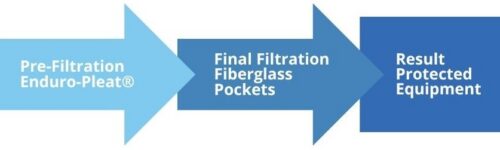
Filtration Group’s engineered filtration strategy combines robust pre-filtration with high-capacity final filtration to maximize protection while minimizing energy consumption.
Stage 1: Enduro-Pleat® Pre-Filtration
The Enduro-Pleat® serves as the first line of defense by capturing larger airborne particles before they reach downstream filtration components.
-
Consistent MERV 8/8A performance throughout the filter’s service life
-
100% synthetic, moisture-resistant media
-
Heavy-duty frame construction designed to prevent bypass and collapse
-
Lower initial pressure drop for improved airflow efficiency
-
Extended service life compared to conventional pleated filters
-
Resistance to microbial growth in demanding HVAC environments
By removing coarse particulate matter early, the Enduro-Pleat® helps protect and extend the life of final-stage filters while maintaining optimal airflow.
Stage 2: Fiberglass Pocket Final Filtration
The second stage utilizes high-capacity fiberglass pocket filters rated at MERV 11. These filters are specifically designed to capture particles in the 1.0–3.0 micron range—the contaminants most likely to accumulate on cooling coils, server boards, and other critical infrastructure.
-
Exceptional dust-holding capacity
-
Low and stable pressure drop
-
Up to 10-pocket configurations for reduced airflow resistance
-
Leak-proof construction to eliminate air bypass
-
Durable galvanized steel frame construction
-
Longer service intervals and reduced maintenance requirements
Why Pressure Drop Matters
One of the most significant yet overlooked factors in filtration performance is pressure drop. Higher pressure drop means HVAC systems must work harder to move air through the filter bank. This increases fan energy consumption and negatively affects overall facility efficiency.
Filtration Group’s two-stage solution is engineered to maintain a lower average pressure drop throughout the filter lifecycle, helping to:
-
Reduce fan energy consumption
-
Improve PUE performance
-
Lower operating costs
-
Extend equipment life
-
Maintain consistent airflow to critical systems
Standard Filters vs. Filtration Group Purpose-Built Solution
Many commodity filters are designed primarily around purchase price rather than total cost of ownership. While they may offer lower upfront costs, they often require frequent replacement, create higher energy expenses, and provide limited protection against fine particulate contamination.
Feature / Outcome |
Commodity Standard Filters |
Filtration Group Two-Stage System |
Filter Lifespan |
Short; requires frequent replacement |
Significantly extended filter life |
Maintenance Burden |
High change-out frequency |
Reduced change-out frequency |
Energy Consumption |
Higher due to rapid pressure drop spikes |
Lower baseline energy consumption |
Structural Integrity |
Prone to bypass and frame leakage |
Improved structural integrity; minimal bypass risk |
Hardware Protection |
Limited defense against fine particulates |
Superior protection for sensitive electronics |
Sustainability |
Higher waste generation |
Lower waste generation and improved outcomes |
Protecting Critical Infrastructure